Additional information
| ISBN | 979-8-89966-879-1 |
|---|---|
| Author | Bogdan Costea, Felicia Chețan |
| Publisher | |
| Publication year | |
| Language | |
| Number of pages | 87 |

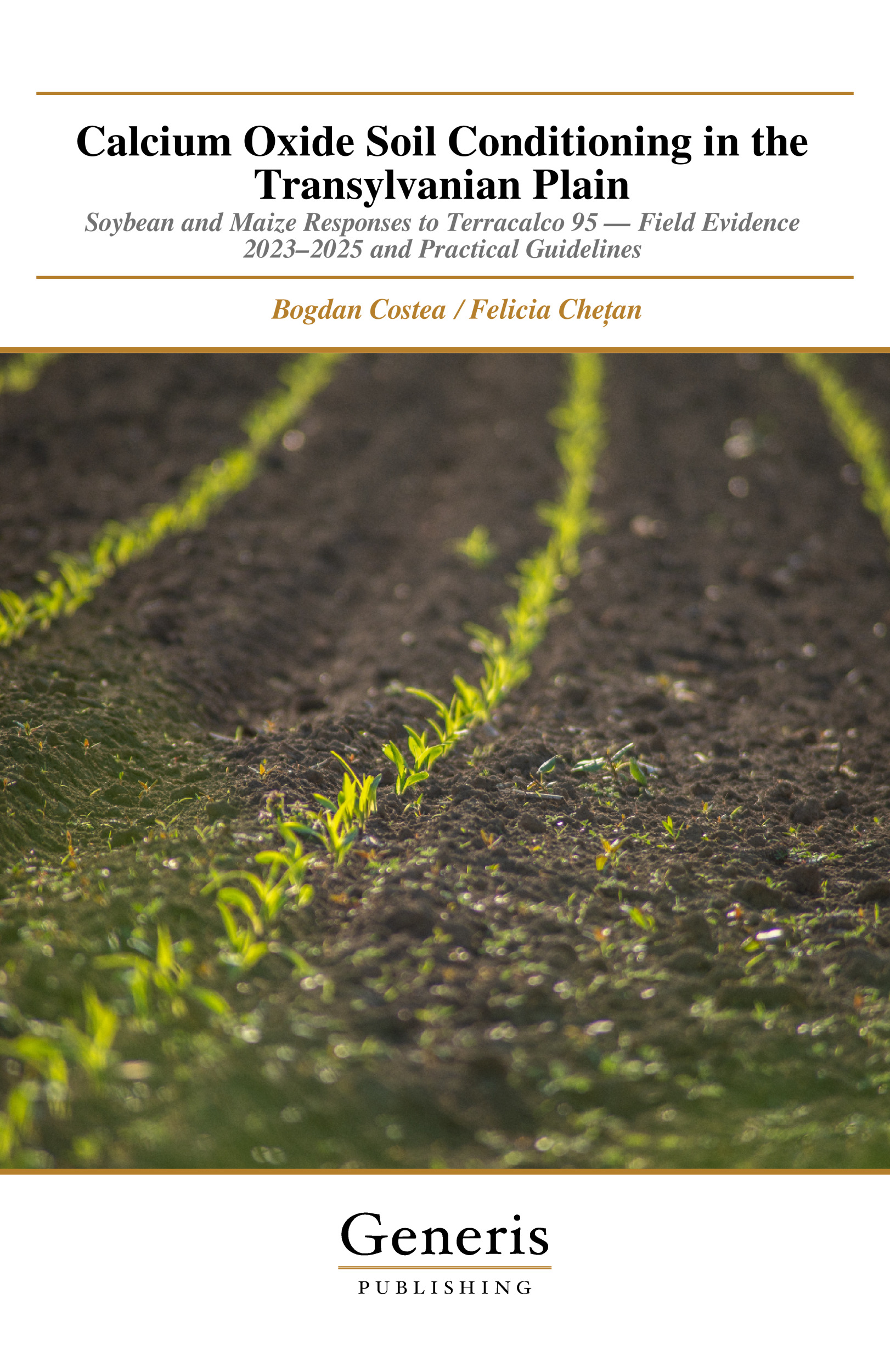
Many heavy soils of Central and Eastern Europe appear neutral when assessed by water pH, yet retain acidity on clay and humus surfaces. On such soils, the choice of calcium source, dose and timing matters. This book expands two published field studies conducted at the Agricultural Research and Development Station Turda, Romania. Across three seasons, […]
ISBN: 979-8-89966-879-1
€31.99
| ISBN | 979-8-89966-879-1 |
|---|---|
| Author | Bogdan Costea, Felicia Chețan |
| Publisher | |
| Publication year | |
| Language | |
| Number of pages | 87 |
Many heavy soils of Central and Eastern Europe appear neutral when assessed by water pH, yet retain acidity on clay and humus surfaces. On such soils, the choice of calcium source, dose and timing matters.
This book expands two published field studies conducted at the Agricultural Research and Development Station Turda, Romania. Across three seasons, soybean and maize were treated with low rates of the fast-acting calcium oxide amendment Terracalco 95 at different stages of the crop cycle. The authors examine the soil data, yield and quality results, and the limits of what the experiments can demonstrate.
The book explains why hydrolytic acidity complements pH in soil diagnosis, why the effect of a low surface-applied dose is expected to be concentrated in the upper 0-5 cm seedbed and early root zone, and how responses differed between a legume and a cereal under contrasting moisture conditions. It also provides a practical method for estimating calcium oxide requirements on acid soils and discusses calcium management on near-neutral and alkaline soils using cation exchange capacity and cation balance. The book was written for agronomists, advisers, students and farmers.