Additional information
| ISBN | 979-8-89966-506-6 |
|---|---|
| Author | Asmaa Mahmoud Kadry |
| Publisher | |
| Publication year | |
| Language | |
| Number of pages | 107 |

Curcumin, a natural polyphenolic compound derived from turmeric, exhibits diverse pharmacological activities including significant antidiabetic effects. However, its clinical application is hindered by poor bioavailability, rapid metabolism, and chemical instability. This book presents a comprehensive computational framework for designing novel curcumin derivatives with enhanced insulin receptor (IR) binding affinity and improved pharmacokinetic properties. rn Through […]
ISBN: 979-8-89966-506-6
€37.99
| ISBN | 979-8-89966-506-6 |
|---|---|
| Author | Asmaa Mahmoud Kadry |
| Publisher | |
| Publication year | |
| Language | |
| Number of pages | 107 |
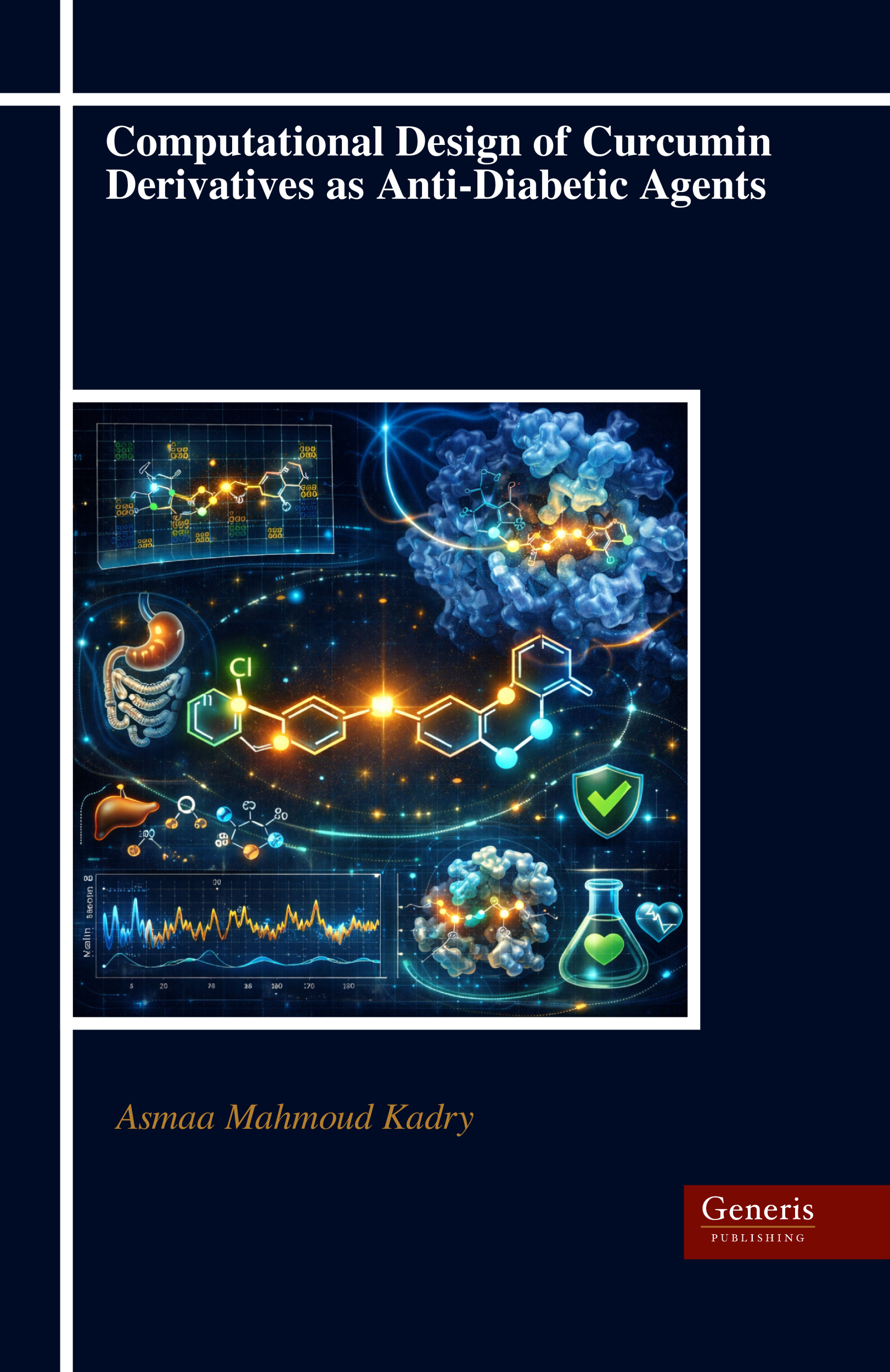
Curcumin, a natural polyphenolic compound derived from turmeric, exhibits diverse pharmacological activities including significant antidiabetic effects. However, its clinical application is hindered by poor bioavailability, rapid metabolism, and chemical instability. This book presents a comprehensive computational framework for designing novel curcumin derivatives with enhanced insulin receptor (IR) binding affinity and improved pharmacokinetic properties.
rn
Through integrated computational strategies, we systematically designed and evaluated multiple curcumin derivatives. Key structural modifications included replacement of the unstable β-diketone moiety with monocarbonyl linkers, introduction of halogen and heterocyclic substitutions, and optimization of aromatic ring functional groups.
rn
Our results demonstrate that optimized derivatives exhibit significantly stronger binding to the insulin receptor, improved stability in molecular dynamics simulations, and favorable ADMET profiles. The derivatives show enhanced gastrointestinal absorption, reduced CYP450 inhibition, and lower predicted toxicity compared to native curcumin and classical analogues like EF24 and PGV-1.