Additional information
| ISBN | 979-8-89966-740-4 |
|---|---|
| Author | Wangdo Kim |
| Publisher | |
| Publication year | |
| Language | |
| Number of pages | 71 |

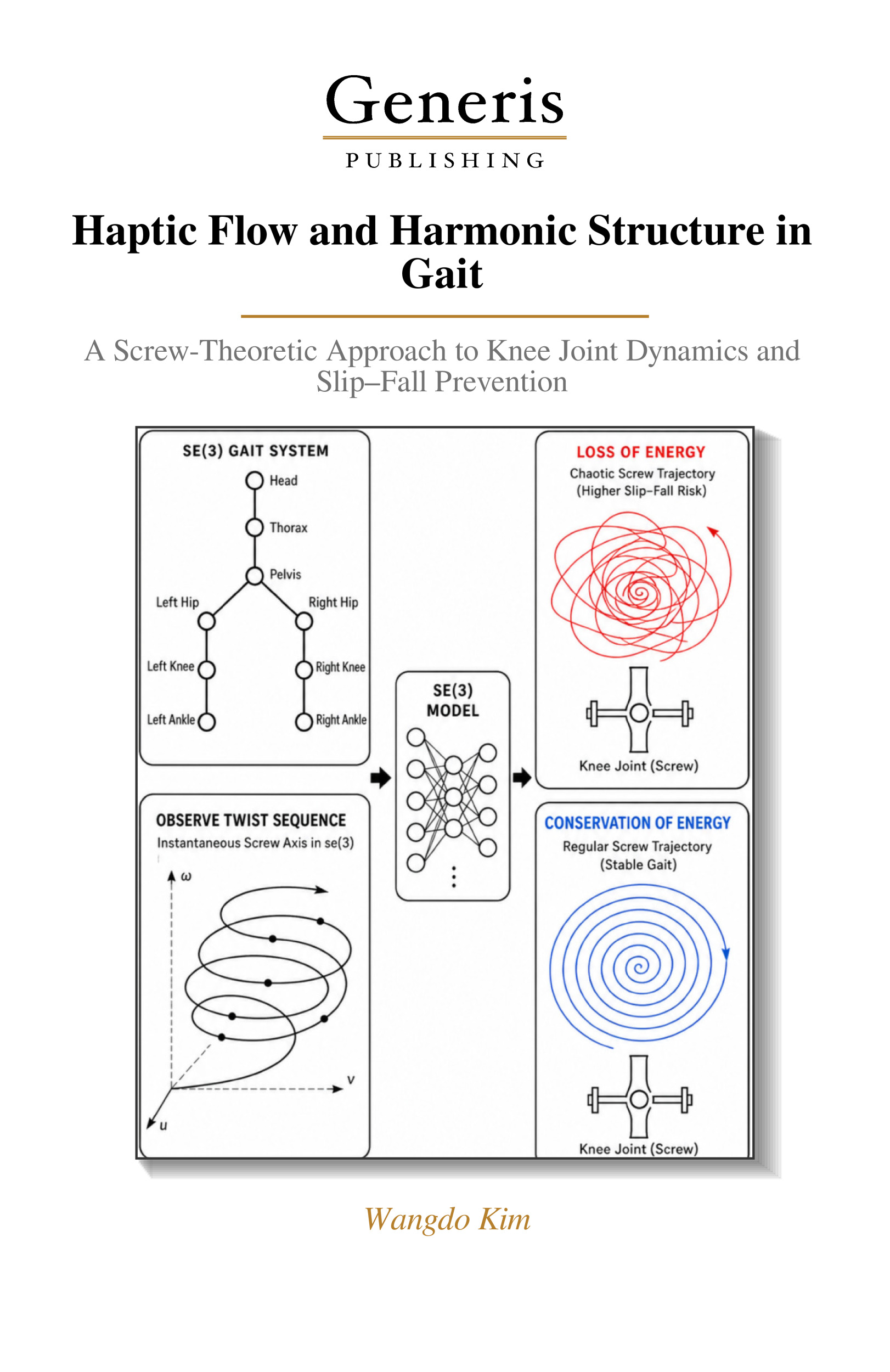
This book develops a unified screw-theoretic framework for understanding human gait as a geometrically organized interaction between the body and the environment. Focusing on the knee joint, it introduces the concept of haptic flow—the structured evolution of instantaneous screw axes and their invariants—as the mechanical counterpart of perceptual information in locomotion. Using the Grand Challenge […]
ISBN: 979-8-89966-740-4
€29.99
| ISBN | 979-8-89966-740-4 |
|---|---|
| Author | Wangdo Kim |
| Publisher | |
| Publication year | |
| Language | |
| Number of pages | 71 |
This book develops a unified screw-theoretic framework for understanding human gait as a geometrically organized interaction between the body and the environment. Focusing on the knee joint, it introduces the concept of haptic flow—the structured evolution of instantaneous screw axes and their invariants—as the mechanical counterpart of perceptual information in locomotion. Using the Grand Challenge knee dataset, the work shows how harmonic relations within a segmental cylindroid and polar reciprocity between the knee screw and ground reaction forces jointly shape stable stance, constrain joint loading, and reduce translational slip. The framework is then extended to interpret limitations of current ACL reconstruction, propose geometric criteria for functional tunnel alignment, and outline testable hypotheses linking breakdown of harmonic–polar structure to slip–fall risk in aging populations.