Additional information
| ISBN | 979-8-89966-488-5 |
|---|---|
| Author | Dr. Chih-Yun Chiang, Dr. Heng-Sheng Lin |
| Publisher | |
| Publication year | |
| Language | |
| Number of pages | 75 |

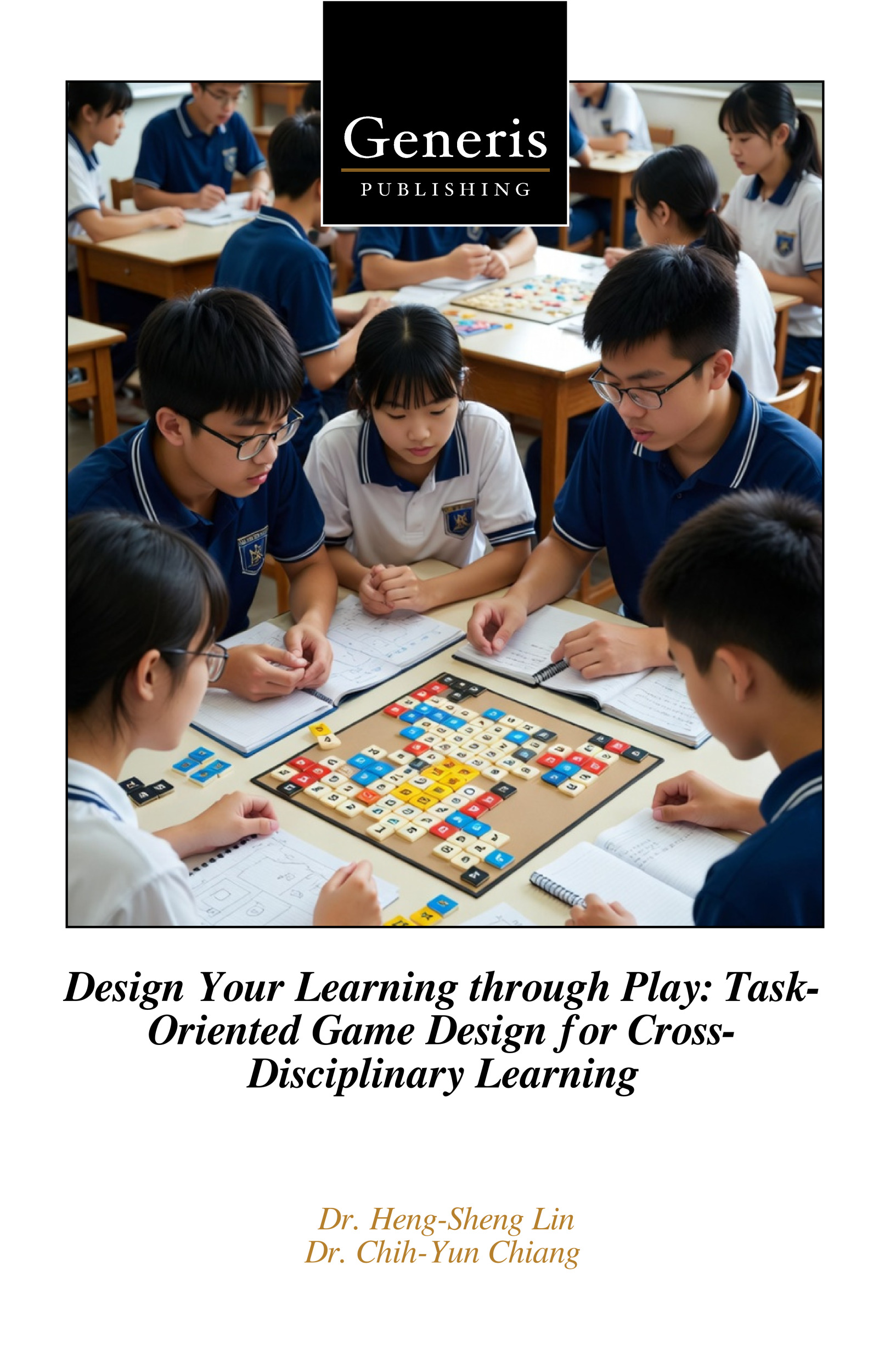
This work proposes a design-oriented approach to game-based learning that positions students not only as players but as designers of educational board games. Grounded in constructionist theory, task-oriented learning, and cognitive apprenticeship, the study argues that learning becomes deeper and more transferable when disciplinary knowledge is transformed into playable rule systems. rn Using Rummikub as […]
ISBN: 979-8-89966-488-5
€29.99
| ISBN | 979-8-89966-488-5 |
|---|---|
| Author | Dr. Chih-Yun Chiang, Dr. Heng-Sheng Lin |
| Publisher | |
| Publication year | |
| Language | |
| Number of pages | 75 |
This work proposes a design-oriented approach to game-based learning that positions students not only as players but as designers of educational board games. Grounded in constructionist theory, task-oriented learning, and cognitive apprenticeship, the study argues that learning becomes deeper and more transferable when disciplinary knowledge is transformed into playable rule systems.
rn
Using Rummikub as a pedagogical grammar, the research demonstrates how linguistic, mathematical, and scientific concepts can be operationalized through student-designed board games. Case designs include Zhuyin Fuhao Rummikub for phonological awareness, English morpheme-based Rummikub for structural vocabulary learning, mathematical operations Rummikub for relational reasoning, and periodic table Rummikub for scientific systems thinking.
rn
Across these implementations, students engaged in iterative cycles of prototyping, playtesting, and revision, thereby integrating content knowledge with higher-order competencies such as abstraction, systems thinking, collaboration, and metacognitive reflection.


